

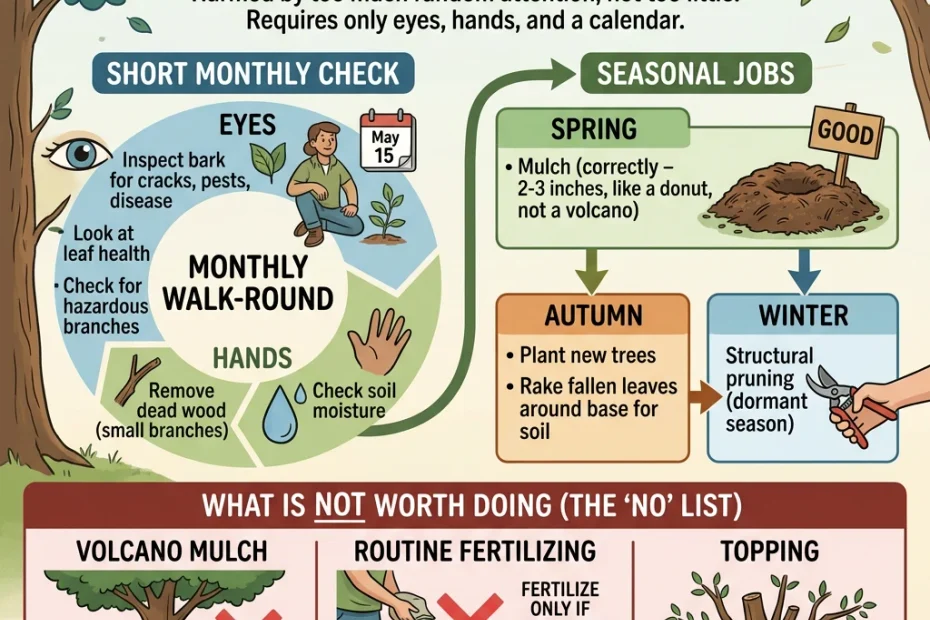
The 15-Minute Tree Care Routine That Beats Constant Fussing
Your tree does not need you checking on it every day, and it does not need a tonic every spring. The established trees I see struggle most are the ones that get random attention: mulch heaped against the trunk, a bag of fertilizer tipped on in a burst of enthusiasm, a saw taken to the crown on a sunny Sunday. A tree care routine of about fifteen minutes a month, plus one job per season, does more good than all of that, and it leaves your weekends free.
Does your tree really need more attention, or just better attention?
Trees live on a timescale that has nothing to do with your schedule. A crack widening, a branch dying back or a fungus appearing at the base develops over weeks and months, so looking at the tree every day mostly teaches you what a tree looks like on an ordinary Tuesday. Looking once a month, the same way each time, shows you what has changed.
Better attention is regular, follows the same checklist and compares this month with last month. It is also quiet. Most months the correct response to what you see is to write it down and walk away.
This routine is for established trees. If yours went into the ground within the last year or so, start with the first thirty days after planting, because young trees need watering far more often than anything described here.
What does a 15-minute monthly walk-round look like?
Pick a route and keep it. Starting at the base and finishing in the canopy works well, and a small timer on your phone keeps you honest.
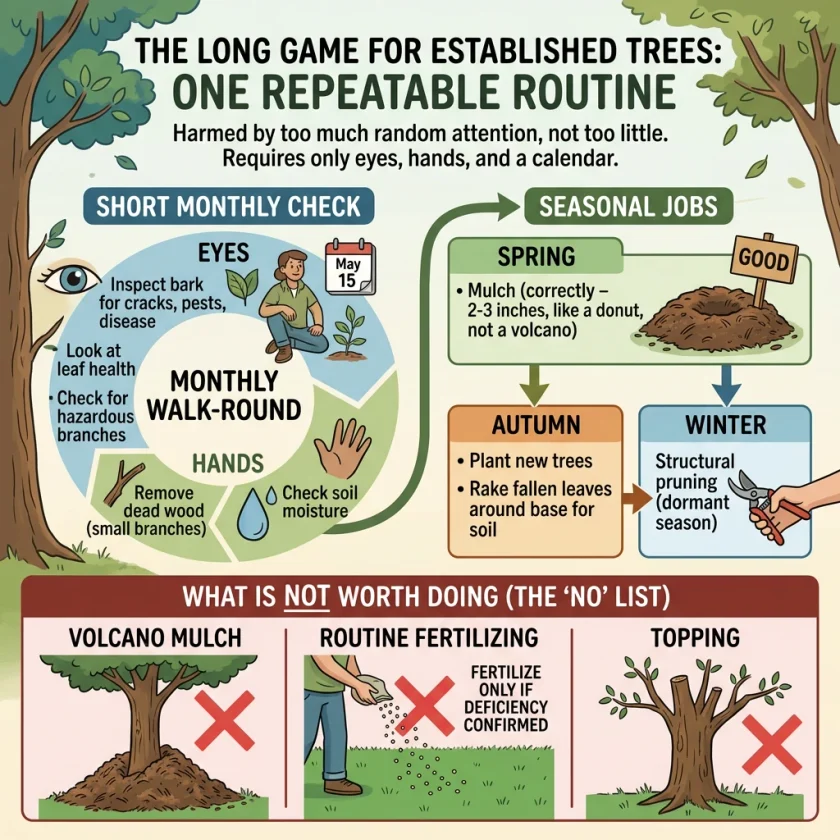
- The base (3 minutes). Look for the trunk flare, where the trunk widens into the roots. It should be visible above the soil. Check for mushrooms or bracket fungi, oozing, cracked bark, or soil that has heaved up on one side.
- The trunk (3 minutes). Walk all the way round. Note vertical cracks, bark peeling off in patches, wounds, small holes and any sawdust-like debris collecting in crevices.
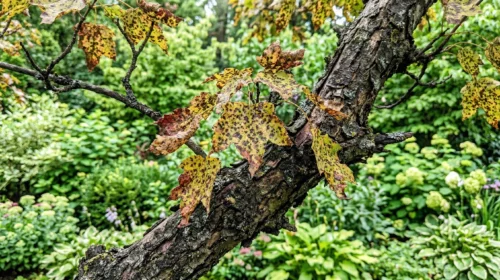
- The canopy (4 minutes). Stand back and look up. Check leaf colour and size, tips that look dead, branches rubbing against each other, and anything hanging or split.
- The soil (2 minutes). Push a trowel or your fingers 10 cm or so into the soil under the canopy. Is it dry, damp or soggy? Look at the mulch too: is it still there, and is it touching the trunk?
- The surroundings (2 minutes). Check for mower or string trimmer damage, new paving or building work near the roots, stakes or ties that have been left on, and cables or wires in the branches.
- The note (1 minute). Write one line in a notebook or phone, and take a photo from the same spot every month. After a year you will have a record that no memory can match.
Most of what you find goes straight into the notes. If you see the same worry two months running, or it is clearly getting worse, ask a certified arborist to look. If a large branch has cracked or the tree has started to lean when it did not before, call someone that day and skip the wait for next month’s walk.
What should you do each season, and why then?
Each season has one reason to do a particular job, and doing it at another time usually costs you something. Here is the calendar in short form.
- Winter (dormant season). Remove dead, broken and crossing branches while they are small. A bare deciduous tree shows its structure clearly, and many pests and diseases are inactive. Check for storm damage too. The exceptions matter: ornamental cherries and other stone fruit (Prunus) are commonly pruned in summer, because winter cuts can let in disease in wet weather. In regions with oak wilt, oaks (Quercus) should not be pruned in the growing season, so check local advice for your area.
- Spring. Watch leaf-out closely. A branch that leafs late or sparsely has often died over the winter, and spring is when you can see which ones. Refresh the mulch while the soil is still moist.
- Summer. Water during dry spells, and look for scorched edges or leaves that wilt in the afternoon and recover overnight. Water demand is highest when the tree is in full leaf and the soil is dry.
- Autumn. Top up the mulch, and give evergreens a good soak in a dry autumn before the ground freezes, since they keep losing water through their needles all winter. Take off any stake or tie that is still on a tree that can stand alone. Autumn is also a good planting season in many climates.
That is four jobs for the year. A tree that gets them reliably will do better than one that gets sixteen jobs done erratically.
How do you water, mulch and feed without overdoing it?
Water. An established tree in a normal climate usually takes care of itself, apart from long dry spells. When you do water, go deep and slow: set a hose to a trickle under the canopy and leave it for a good while, rather than sprinkling every evening. Shallow daily watering keeps roots near the surface, where they dry out first. Then check, by digging down, that the water has actually reached the roots. Soggy soil is also a problem, because roots need air as well as water.
Mulch. Spread shredded bark or wood chips in a wide ring, as wide as you can manage, about 5 to 10 cm (2 to 4 inches) deep. Keep it a hand’s width away from the trunk. Mulch holds moisture, moderates soil temperature and keeps mowers and trimmers away from the bark, which is a job worth doing on its own.
Feed. Trees growing in the ground get most of what they need from the soil and from their own fallen leaves. Leaving leaves under the tree, or mulching them in place, returns nutrients for free. Fertilize only when a soil test shows a deficiency or a qualified professional has matched the symptoms to a specific shortage. A bag of general-purpose feed applied on a hunch can push soft growth, feed the lawn and the weeds instead, and tell you nothing.
Which popular tree jobs are not worth your weekend?
A routine is as much about what you stop doing as what you start. These four are common, well meant and best skipped.
- Volcano mulch. A cone of mulch piled against the trunk keeps the bark damp, which invites rot and pests, and it encourages roots to grow around the trunk instead of away from it. Flatten it into a doughnut, with the hole around the trunk.
- Routine fertilizing. Without a deficiency to correct, you are spending money to change something that was not broken. Spend that money on a soil test instead.
- Topping. Cutting the main branches back to stubs leaves large wounds that decay, and the tree responds with a crowd of fast, weakly attached shoots that are more likely to break than the original branches. If a tree has outgrown its spot, the choices are careful reduction by an arborist or replacing it with a species that fits the space.
- Wound paint and sealants. Painting over pruning cuts is a habit that has outlasted the advice. Make clean cuts just outside the branch collar and let the tree seal the wound itself.
Skipping these gives you back an afternoon or two a year, which you can spend sitting under the tree with a drink. The tree will not mind.
How do you adapt the routine to your species and climate?
The structure stays the same everywhere, but timing and emphasis change.
By species:
- Maples (Acer) can bleed sap from cuts in late winter and early spring. It looks alarming and is generally harmless, though it is easier to avoid by timing your cuts. They also have shallow roots that dislike compaction, so keep the mulch ring free of traffic. If you are still choosing, why maples suit so many yards explains their appeal.
- Oaks (Quercus) are slow and tough, and they do not enjoy changes to the soil level around the roots. Piling fill over the root zone does more harm than almost any disease. Check local guidance on oak wilt before any pruning.
- Conifers (Pinus, Picea) rarely need pruning. Many do not regrow from bare old wood, so a cut back past the green growth can be permanent.
- Fruit trees (Malus domestica and relatives) are the exception to the “less pruning” idea. They usually need annual shaping and thinning to crop well, so add that to the winter job.
By climate:
- In dry-summer regions, watering and mulch carry the routine.
- In cold regions, the autumn soak for evergreens and keeping de-icing salt away from roadside trees matter most.
- In wet climates, watch drainage and look at the base more carefully for fungi.
For exact dates, such as when the last hard frost usually falls where you live, ask your local extension service, forestry office or arborist association. They know your area better than any general article can.
How do you keep a routine going when life gets busy?
The routine fails when it needs willpower, so give it a fixed place in the week instead. A repeating calendar event for the first Saturday of the month works, and so does attaching the walk-round to something you already do, like taking the bins out or finishing a coffee in the garden.
Put the four seasonal jobs in the calendar too, with their names: “Winter: small dead branches”, “Autumn: mulch and evergreen soak”. When the reminder pops up you will not need to remember what it meant.
Have a five-minute version ready for bad months. Look at the base and the canopy, take the photo and go in. A shortened walk-round still keeps the record going, and a missed month is only a gap in the notes. If you enjoy gadgets, AI-driven tree maintenance shows what software can add later, but nothing in this routine needs more than your eyes, your hands and a calendar.
Related Posts






Send this routine to one friend who has a tree they keep meaning to look after, and tell me which season’s job you will do first. ☕
Invest in your future
Take time to learn

Begin your path in affiliate marketing and website building with a supportive community and me. Commit time to learning and earning as an investment in your future. Use whatever time you require to master the fundamentals before pursuing greater goals. Try it and register for free. You will not regret it—explore the potential yourself…And create your own with help of AI tools and agents