

Your Zone Number Is Only Half the Story When Picking a Tree
How to choose trees for your climate zone
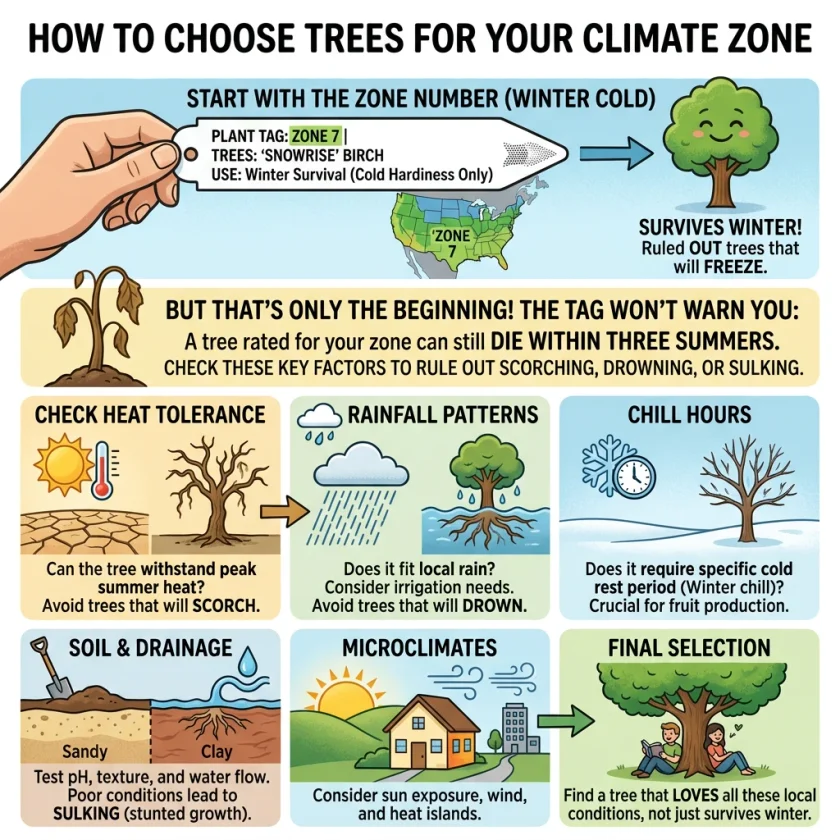
The zone number on a plant tag tells you one thing: how much winter cold a tree should survive. To choose trees for your climate zone properly, use that number to rule out trees that will freeze, then check heat, rainfall, chill hours, soil and microclimate to rule out the ones that will scorch, drown or sulk. A tree rated for your zone can still die within three summers, and the tag will not warn you.
What does your climate zone actually tell you (and what does it quietly leave out)?
The USDA hardiness system divides North America into bands based on the average coldest winter temperature of the year. Each zone is 10°F (about 5.6°C) wide, split into “a” and “b” halves of 5°F. A tree rated zone 5 should survive a typical coldest night down to roughly -20°F (-29°C). That is a useful fact if you live somewhere with real winters.
What it leaves out is nearly everything else a tree lives through. The number says nothing about how hot July gets, how long the heat lasts, or whether it rains in summer or only in winter. It does not mention soil, wind, humidity or how many cold hours a fruit tree needs to flower. It also describes an average, so one freak winter can fall well below it.
Think of the zone as a bouncer at the door. It keeps out the trees that will certainly freeze. It does not check whether the ones it lets in will enjoy the party.
How do you find your zone if you do not live where zones are given in USDA numbers?
Zones exist almost everywhere, just under different names. Look for the system your own country’s gardeners and nurseries use:
- United Kingdom: the Royal Horticultural Society rates plants H1 to H7, where H4 means hardy through an average UK winter and H7 means hardy through very severe winters.
- Canada: Natural Resources Canada publishes its own plant hardiness zones, which include factors beyond minimum temperature, such as rainfall and snow cover.
- Europe: many nurseries print USDA-equivalent zones on labels, and maps of European hardiness zones are widely available.
- Australia: the Australian National Botanic Gardens has published hardiness zone maps, though most local advice is given by region and climate type (tropical, arid, temperate, Mediterranean).
- Anywhere else: the Köppen-Geiger classification sorts the world into climate types such as humid continental, Mediterranean, tropical and semi-arid. It describes your whole climate pattern, not only your winter low.
If nothing local turns up, convert your coldest recorded winter temperatures into the USDA scale. Take the lowest temperature of each winter for the past ten years or so, average them, and find the matching band. Your local weather service or a nearby airport station will have the data.
Then do the part the zone cannot do for you: find out how your area behaves across the other three seasons.
Which other climate factors decide whether a tree thrives: heat, rainfall, chill hours and wind?
Cold gets the headlines, but these four do much of the quiet damage.
Heat. Some trees are comfortable at -30°F and miserable at 95°F. The American Horticultural Society publishes a heat zone map (1 to 12) based on the number of days per year above 86°F (30°C). Where no such map exists, check how many days your area passes 30°C and how warm the nights stay. Many cool-climate trees need cooler nights to recover from daytime stress.
Rainfall and its timing. A tree that suits 1,000 mm of rain spread through the year may fail in a place that gets the same amount in a single wet season followed by six dry months. Coast redwood (Sequoia sempervirens) is rated for zones 7 to 9, yet it depends on coastal fog and mild summers. Plant one inland in dry heat and it will brown from the tips down, while the tag remains perfectly accurate about its cold tolerance.
Chill hours. Many fruit and nut trees need a minimum number of hours between roughly 0°C and 7°C (32°F to 45°F) during winter to break dormancy and flower properly. Too few and they leaf out late, flower patchily and crop poorly. Sweet cherry (Prunus avium) is a classic victim in mild-winter regions. Low-chill varieties of apple and peach exist for those climates, so ask the nursery for the chill requirement of the exact cultivar.
Wind. Constant wind dries leaves, bends young trunks and carries salt near a coast. A tree that is tough against frost can still shred in an exposed spot. Wind also makes cold feel colder to the tree, because it strips moisture from evergreens when the ground is frozen and roots cannot replace it.
Why does the same tree sulk in one yard and thrive three streets away? Reading your microclimate
Your property has its own weather, and you can map it with a notebook and a few days of attention. The main influences are:
- Walls and pavement. A wall facing the sun (south in the Northern Hemisphere, north in the Southern) stores heat and can behave like a zone warmer. Paving and dark surfaces reflect heat onto the tree, which suits a fig and scorches a Japanese maple.
- Low spots. Cold air is heavy and drains downhill, so the bottom of a slope collects frost. A tree on the hillside above can come through a night that kills the same tree in the hollow.
- Cities. Dense built-up areas stay several degrees warmer than the countryside around them, which is why some borderline trees do well in town gardens and fail a few kilometres out.
- Shelter and exposure. Neighbouring buildings, hedges and larger trees break the wind and shade the soil. They also steal water, which matters under a mature tree’s canopy.
- Soil. Clay holds water and can suffocate roots after heavy rain. Sand drains fast and dries out. Alkaline soil causes yellowing in acid-lovers such as pin oak (Quercus palustris), which develops chlorosis because it cannot take up enough iron. A cheap pH test kit saves you from learning this the slow way.
Walk your garden on a frosty morning, on a hot afternoon and after a heavy rain. Note where frost lingers, where the soil stays soggy and where the wall is too hot to touch. Ten minutes of watching beats most online maps.
Which trees suit cold, temperate, hot and dry, and humid climates? Real species, and the ones to skip
The lists below are starting points. Local nurseries know which cultivars work in your area, so confirm there before you buy.
Cold climates
Good matches: paper birch (Betula papyrifera) and white spruce (Picea glauca) are hardy to zone 2. Tamarack (Larix laricina) is a deciduous conifer that handles very cold, wet ground. Quaking aspen (Populus tremuloides) covers vast northern ranges, though it is short-lived and suckers freely.
Skip: paper birch in a hot, dry garden further south. It may survive the winters, but heat stress leaves it open to bronze birch borer. Also skip any peach variety bred for mild winters if spring frosts regularly hit the open flowers.
Temperate climates
Good matches: English oak (Quercus robur), small-leaved lime (Tilia cordata), European hornbeam (Carpinus betulus) and red oak (Quercus rubra) all suit regions with moderate rainfall and four distinct seasons. If you like oaks, the majesty of oak trees shows why they repay the wait.
Skip: European beech (Fagus sylvatica) on compacted or waterlogged soil. It looks like a gift of the temperate zone and sulks like a diva if its roots sit wet.
Hot and dry climates
Good matches: olive (Olea europaea), holm oak (Quercus ilex), Aleppo pine (Pinus halepensis), carob (Ceratonia siliqua) and blue palo verde (Parkinsonia florida). These evolved with long dry summers and handle both heat and drought once established. Certain eucalypts, such as river red gum (Eucalyptus camaldulensis), also do well, though they are big trees and need space and a check on local planting rules.
Skip: Japanese maple (Acer palmatum) in full afternoon sun, which scorches its leaf edges, and willows (Salix) unless you have a reliable water source. Willow roots will go looking for water, often in your drains.
Humid climates
Good matches: bald cypress (Taxodium distichum) copes with both wet feet and dry spells. Southern magnolia (Magnolia grandiflora), live oak (Quercus virginiana) and black gum (Nyssa sylvatica) also like warm, wet summers.
Skip: olive in persistently humid places, where fungal leaf diseases become a problem, and true firs such as Fraser fir (Abies fraseri) at low elevation in hot, humid regions, where root rot is a common reason they fail.
If you like maples, why maple trees are perfect for any yard covers which ones fit which gardens. Check the species before you buy, because “maple” spans trees from cold-loving sugar maple to heat-tolerant types.
Is it worth pushing your zone? When a stretch pick pays off and when it is just a pricey compost project
Gardeners like to cheat the zone a little, and sometimes it works. The question is what you are asking the tree to do.
A stretch of half a zone, or one zone, is realistic when the problem is only winter cold and you can soften it. A sheltered south-facing spot, thick mulch over the roots, protection from wind, and a hardy cultivar all help. Windmill palm (Trachycarpus fortunei) is the standard example: it grows well in places like the UK, well beyond tropical conditions, because it tolerates cold better than its looks suggest. Some southern magnolia cultivars, such as ‘Edith Bogue’, are bred for colder zones than the species handles.
A stretch fails when the missing ingredient is something you cannot supply:
- Chill hours. You cannot cool a whole yard for 800 hours. A cherry in a warm-winter city will leaf and flower in the wrong order, year after year.
- Summer heat or humidity. A tree built for cool, dry summers will not forgive a tropical July. Shade cloth helps a seedling, not a mature tree.
- Growing season length. Mango, coconut or cacao in a place with frost is a ceremonial funeral in a pot. Even if you keep one alive indoors, it will not behave like the tree on the tag.
A useful test: if you can fix the problem with mulch, a wall or a windbreak, try it. If you would have to change the weather, buy a different tree. Container-grown citrus that spends winter in a bright, frost-free room is a fair compromise for cold-climate growers who want lemons, as long as you accept that it is a houseplant with ambition.
A five-step method for choosing your tree
- Find your hardiness zone using the system for your country, or work out the equivalent from your ten-year average of winter lows.
- List your other limits: summer heat, annual rainfall and when it falls, winter chill hours (if you want fruit or nuts), prevailing wind and any salt exposure.
- Read your site: note frost pockets, sun and shade across the day, soil type and pH, drainage, and how much space there is above and below ground.
- Match species to the full list. Shortlist trees whose native range or proven performance fits all of it, not only the cold limit. Ask a local nursery or extension service which cultivars do well nearby.
- Choose the purpose last. With your shortlist ready, pick for shade, fruit, flowers, wildlife or screening. It is much easier to choose among five trees that will live than among fifty that look nice.
Once you have your tree, the next job is getting it into the ground well. The first thirty days decide a tree’s next thirty years covers planting and early aftercare, and it is the right next read.