

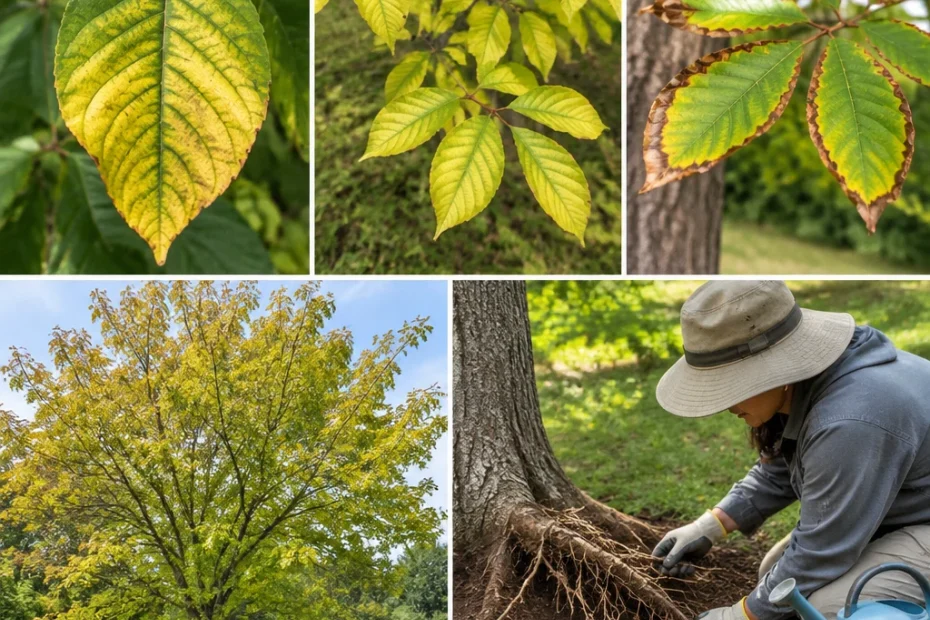
Most common nutrient problems in yard trees
Tree nutrient deficiency symptoms show up in leaf colour, leaf size and the position of the damage on the tree. Before you blame the soil, check watering, roots, soil pH and a soil test, because most yellow leaves have a cause that fertilizer will not fix.
This guide walks through that order of checks, shows how to read the leaves, and covers what to do and what to skip.
Rule out the boring causes first
A tree that cannot take up nutrients looks the same as a tree that lacks them. Fertilizing the first kind adds salts to a root system that is already struggling. Work through this checklist before you buy anything.
- Watering. Dig a hand trowel 6 inches down near the drip line. Soggy soil means too much water, and dry dusty soil means too little. Both cause yellowing, browning and early leaf drop.
- Drainage. Standing water after rain starves roots of oxygen. Roots that cannot breathe cannot absorb nutrients.
- Planting depth. Look for the root flare, the point where the trunk widens at the base. If it is buried, the tree was planted too deep or has been smothered by soil or mulch.
- Mulch. Mulch should sit 2 to 4 inches deep and stay clear of the trunk. A mulch volcano against the bark holds moisture where it does not belong.
- Compaction. Foot traffic, parked cars and building work squeeze the soil and shut down root growth.
- Girdling roots. A root that wraps around the trunk base chokes the flow of water and sugars. The crown above it often looks pale and thin.
- Chemicals. Lawn weed killers, road salt and spilled fuel all burn leaves in patterns that look like deficiency.
- Season. It is mid November, so yellow and red leaves are probably just autumn. Judge colour problems in spring and summer.
If one of these turns up, fix it first and wait a full growing season. Many “deficient” trees recover without any fertilizer.
Read the leaf before you blame the soil
Once the boring causes are cleared, the leaf tells you a lot. Ask three questions in order.
- Where on the tree does it start? Some nutrients move inside the tree. When supplies run short, the tree pulls them out of old leaves and sends them to new growth, so old leaves show the damage first. Nitrogen, potassium, magnesium and phosphorus behave this way. Other nutrients stay where they are. Iron, manganese, zinc and calcium problems appear on the newest leaves at the shoot tips.
- What does the colour pattern look like? Even yellowing across the whole leaf points one way. Yellow tissue with green veins points another. Brown crisp edges point to a third cause.
- Is the whole tree affected, or one side? One damaged branch or one side of the crown usually means a root, a wound or a physical cause. A whole crown changing evenly points to soil or water.
Write the answers down or take a photo of a few leaves next to a healthy one. A photo from today is useful when you compare it with next spring.
Match the symptom to the usual suspect
These are the patterns seen most often in yard trees. Treat each match as a suspect, not a verdict.
Pale, even yellow on older leaves
This usually points to nitrogen. The whole leaf fades to light green or yellow, starting on the lower or inner leaves. Growth is slow, new leaves are small, and shoots add very little length in a season. It is most common in young trees that compete with lawn grass and in sandy soil where nitrogen washes away. Heavy mulch made of fresh wood chips can also tie up nitrogen at the soil surface for a while.
Yellow leaf with green veins on new growth
This is iron deficiency, called iron chlorosis. The tissue between the veins turns yellow while the veins stay green, and it hits the youngest leaves first. In bad cases leaves turn almost white and the edges scorch.
The soil often contains plenty of iron. The trouble is a high pH, which locks iron into forms roots cannot use. Species known to suffer include pin oak (Quercus palustris), red maple (Acer rubrum) and river birch (Betula nigra) when planted in alkaline soil. If you are still choosing a tree for a yard, the notes in Why Maple Trees Are Perfect For Any Yard are a good place to match species to soil.
Yellow between the veins on new leaves, with small dark spots
This is often manganese deficiency. It looks like iron chlorosis, but the veins stay green in a finer network and the leaves can show tiny dead flecks. It is also tied to high pH, and maples are a frequent victim. The two are hard to separate by eye, which is another reason to test before you treat.
Yellow edges and scorched margins on older leaves
This suggests potassium. The leaf edges yellow, then turn brown and crisp, while the centre may stay green. Compare it with drought scorch, which looks almost the same, and rule out salt and dry roots before you decide.
Yellow between veins on older leaves
This suggests magnesium. Old leaves develop yellow bands between green veins, often starting at the margins. On conifers, the tips of older needles turn yellow or bronze. It tends to appear in acidic, sandy soils that leach easily.
Small, narrow leaves in tufts
This can be zinc deficiency. Leaves stay small and narrow, and the shoot tips bunch into a rosette with short gaps between leaves. It occurs mostly in alkaline or very sandy soil and is a known issue in some fruit and nut trees.
Purple or reddish tint on older leaves
This can be phosphorus, but it is rare in established trees. More often it comes from cold, wet soil that slows root activity in spring. Wait for warm weather before reacting.
Test the soil before you spend a cent
Leaf symptoms narrow down the possibilities. A soil test gives you the number that settles it. A basic test from a local extension service or a commercial lab is cheap compared with a wasted bag of fertilizer or a dead tree.
Follow these steps for a useful sample.
- Use a clean trowel and bucket.
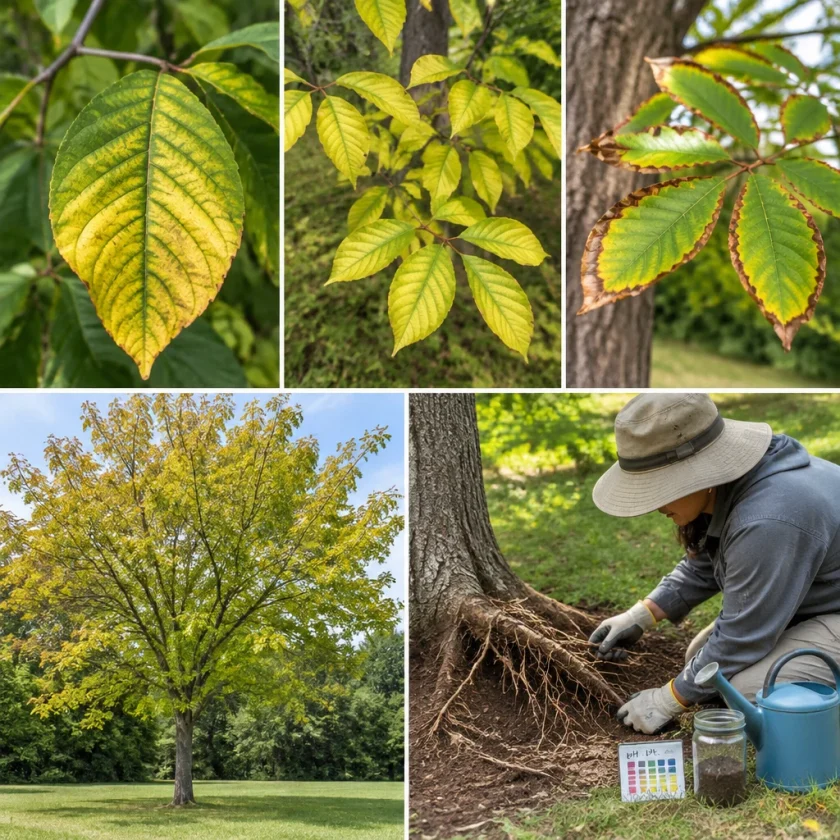
- Take 6 to 8 small samples from around the tree, between the trunk and the drip line, at a depth of 4 to 6 inches.
- Skip spots where fertilizer, compost or ash was dumped.
- Mix the samples, let the soil air dry, and send about a cup.
- Ask for pH, organic matter, and the main nutrients. If the lab offers a leaf tissue analysis, it is worth the extra cost for a valuable tree.
Read pH first. Most yard trees do best in slightly acidic to neutral soil, roughly pH 6 to 7. Above that range, iron, manganese and zinc become harder to absorb. Below it, aluminium and manganese can reach toxic levels and magnesium can run short. A test that shows a pH of 7.8 and plenty of iron explains iron chlorosis better than any amount of staring at a leaf.
Remember that lawn fertilizer lands on tree roots too. If the grass under the tree is fed twice a year, the tree is already getting nitrogen, and the test will show it.
Fix the cause, not just the colour
Spraying or feeding a yellow tree changes the leaf colour for a few weeks at best. A lasting fix removes the cause the test and checklist uncovered.
- Water problems. Water deeply and less often. A slow soak every week or two in dry weather beats a daily sprinkle. Improve drainage or move downspouts away from the root zone.
- Planting and mulch problems. Pull mulch back from the trunk and expose the root flare. A tree planted too deep needs an arborist’s opinion before anyone digs.
- Compaction. Mark off the root zone, keep traffic away, and add a layer of mulch over bare soil.
- High pH. Elemental sulfur lowers pH over many months, and it takes patience. For a stubborn case, an arborist can apply chelated iron or other treatments for faster relief, though these treat symptoms and may need repeating each year.
- Real shortage. If the test shows low nitrogen, a slow release fertilizer applied at the label rate, spread across the root zone, is a sensible fix. Follow the test report, not the front of the bag.
- Poor soil in general. Mulch and time build organic matter, which holds nutrients and feeds soil life.
Then wait. A tree’s response shows in the next flush of new leaves, not in the damaged ones, which stay yellow for the rest of the season.
Skip what is not worth doing
Some popular habits cost money and help nothing.
- Fertilizing blind. Adding a general feed without a test can push pH further the wrong way, burn roots or feed the lawn instead.
- Fertilizing a thirsty tree. Fertilizer salts draw water, so a drought stressed tree gets worse.
- Heavy feeding of newly planted trees. A young tree needs roots first. Water and mulch help it more than fertilizer does.
- Lime on a hunch. Lime raises pH. If your soil is already alkaline, it makes iron chlorosis worse.
- Nails, coins and “tree tonics”. Hammering iron nails into a trunk wounds the tree and does not cure chlorosis. Vitamin and hormone tonics sold for transplants have weak evidence behind them.
- Fertilizer spikes pushed into the ground. They concentrate salts in small spots and miss most of the root zone.
- Panicking in autumn. Falling and colouring leaves are normal now. Come back in spring.
Common Questions
How long does it take to see a tree recover?
A tree usually shows improvement in the next season’s new leaves. Damaged leaves do not turn green again, so judge progress by the leaves that grow after the fix.
Can a tree have more than one problem at once?
Yes, and it is common. Compacted soil, high pH and a lawn that competes for water can all be present together. Fix the cheapest and most obvious ones first, then retest.
Is a yellow leaf always a nutrient problem?
No. Overwatering, drought, root damage, chemical burn, pests and natural ageing all cause yellow leaves. Nutrient problems are one possible answer, and they should be the last one you confirm.
When should I call an arborist?
Call one if the tree is large, valuable, close to a building, or has dieback, a leaning trunk, soft wood or girdling roots. A certified arborist can also treat chlorosis with methods that are hard to do safely at home.
Does every tree need regular fertilizer?
No. Healthy, established trees in decent soil often need none. A soil test tells you whether yours is the exception.
Next step
Read the backyard tree problems guide for the next step, then send this article to a neighbour whose maple looks suspiciously pale. Referrals are how this tree community grows, and a pale maple deserves a kind word before it gets a fertilizer bag. 🌳